
Category: World Coffee

Traditional coffee recipes from Turkey, Vietnam, Mexico, Lebanon and beyond.

  • Turkish Coffee: The Complete Traditional Method

    Turkish Coffee: The Complete Traditional Method

    Authentic Turkish coffee is made with a simple 1:10:1 ratio—one part finely ground coffee to ten parts water to one part sugar—and costs roughly $0.35 a cup at home compared to $4 or more at a specialty café. I’m Ahmed, and after years of trial and error (and a few bitter, foamless disasters), I’ve dialed in a method that works on any stovetop. This isn’t just another strong coffee; it’s a specific preparation with its own rules, equipment, and rhythm that yields a uniquely thick, aromatic, and foamy cup.

    The secret isn’t in exotic beans, but in the grind size, the heat control, and a humble pot called a cezve (or ibrik). You can absolutely master this at home without any fancy gear. The payoff is immense: a rich, ceremonial coffee experience for a fraction of the café price, and the ability to make it exactly to your taste.

    ↓ Jump to Recipe

    Key Takeaways

    • The essential ratio is 1:10:1—1 part coffee to 10 parts water to 1 part sugar.
    • Coffee Recipes’ homemade version costs about $0.35 per cup versus $4+ at a café.
    • Total time is under 8 minutes, with most of it spent watching the pot.
    • The single most important tip is never to stir after the foam forms.
    What’s in this guide

    What is Turkish Coffee?

    Turkish coffee is a method of preparing unfiltered coffee where ultra-fine grounds are simmered with water and sugar (if desired) in a special pot, served directly into a cup where the grounds settle. While its origins are rooted in the Ottoman Empire and it remains a cultural staple in Turkey and across the Middle East and Balkans, the technique is universal. According to UNESCO, which inscribed Turkish coffee culture on its Intangible Cultural Heritage list, it’s a symbol of hospitality, conversation, and community.

    Why This Ratio Works (The 1:10:1 Rule)

    Getting Turkish coffee right hinges on a balanced ratio that accounts for the fact you’re drinking the grounds. My go-to, and the standard I recommend starting with, is a weight-based 1:10:1 ratio of coffee to water to sugar. For one serving, that’s 7 grams of coffee (about 1 heaping teaspoon), 70 ml of water (about 1/3 cup), and 7 grams of sugar (about 1 level teaspoon). This ratio ensures the coffee has enough body and strength from the high dose of fine grounds, while the water quantity allows for proper extraction and the formation of the crucial foam (kaymak or köpük). The equal part sugar balances the intense, concentrated brew without masking its flavor. Deviate too far, and you’ll get a weak, watery cup or an overly thick, sludgy one.
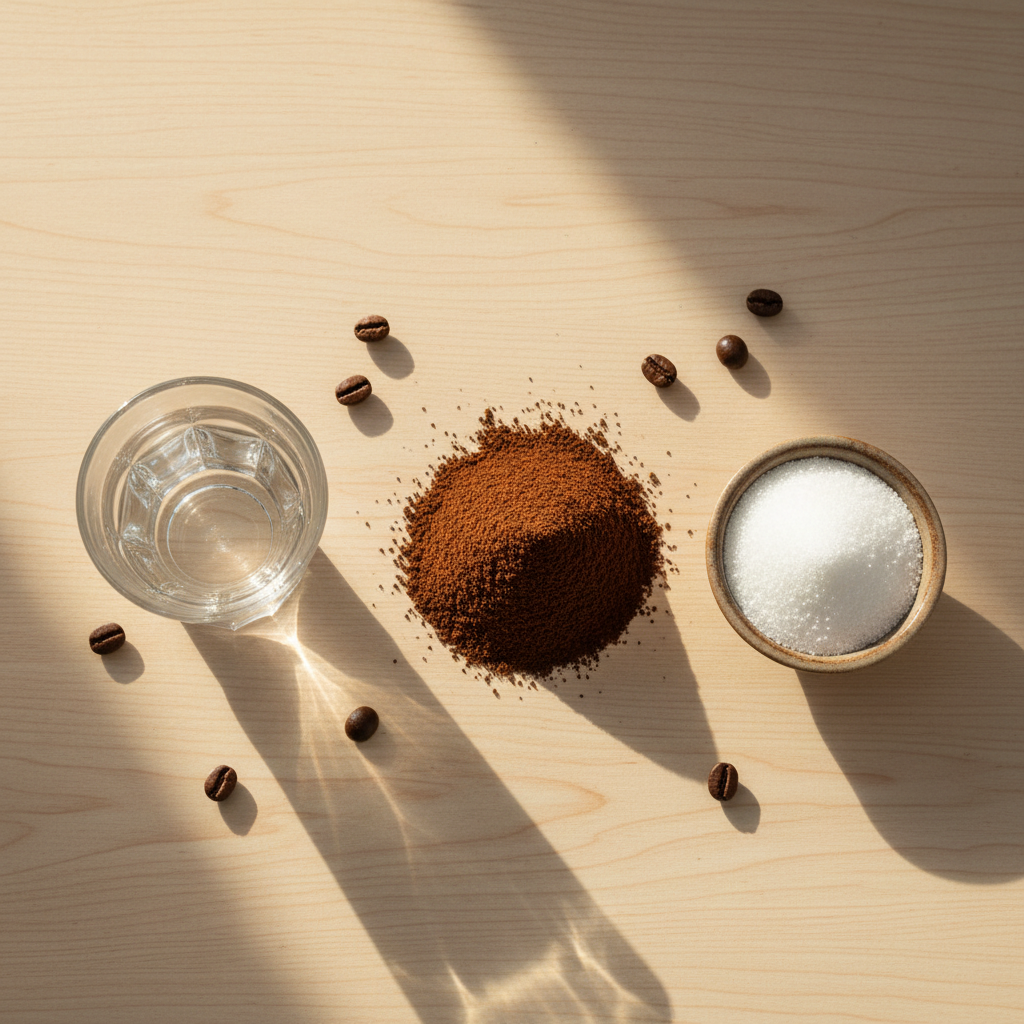
    Ingredients for Turkish Coffee: The Complete Traditional Method
    Everything you need — no specialty gear required.

    Ingredients You’ll Need (And Why They Matter)

    You only need three core ingredients, but their quality and specification are non-negotiable.

    • Coffee: You must use coffee ground to a powder-fine, flour-like consistency. Pre-ground “Turkish” coffee from brands like Kurukahveci Mehmet Efendi or Özerlat is ideal and authentic. If grinding yourself, you need a high-quality burr grinder capable of a Turkish setting. A blade grinder will not work. The fine grind creates maximum surface area for extraction in a short brew time and is responsible for the thick texture.
    • Water: Use cold, fresh water. I use filtered water for the cleanest taste. The volume is critical—too much water and the coffee won’t foam properly; too little and it will be overly strong and thick.
    • Sugar (Optional): White granulated sugar is traditional. The sugar is added before brewing, which allows it to caramelize slightly and integrate fully. The amount is customizable: sade (no sugar), az şekerli (little sugar, ~1/2 tsp), orta şekerli (medium sugar, ~1 tsp), şekerli (sweet, ~1.5 tsp).

    Essential Equipment

    You need one specialized piece of equipment, and your stovetop.

    • Cezve/Ibrik: This small, long-handled pot with a tapered neck is designed to encourage foam formation. They come in copper, brass, or stainless steel. A 1-2 cup size is perfect for home use. The tapered top helps trap the foam when you pour.
    • Heat Source: A gas stove is ideal for precise, low heat control. An electric coil or induction cooktop works, but you must be extra vigilant with heat. A small, low flame or heat setting is key.
    • Cup: A traditional Turkish coffee cup (fincan) is small (60-90 ml), but any small demitasse or espresso cup works.
    • Spoon: For stirring initially.
    • No Cezve? While not ideal, you can use the smallest heavy-bottomed saucepan you have. The results won’t be as authentic, as the wide mouth prevents good foam formation, but you can still brew the coffee. Monitor it even more closely.

    Step-by-Step Technique Tips

    The process is simple but requires attention. First, combine cold water, coffee, and sugar (if using) in the clean, dry cezve. Stir only at this point until just combined—you want the grounds saturated, not frothy. Place the cezve on the lowest possible heat. Patience is everything. Let it heat slowly; you should see a ring of tiny bubbles form around the edge after 3-4 minutes. As it heats, a dark foam will begin to rise. Just before it boils over, remove it from the heat. Let the foam settle for 10 seconds, then return it to the heat to rise again. Do this 2-3 times to build a thick, persistent foam. The National Coffee Association notes that this slow heating is crucial for proper extraction. Finally, off the heat, spoon a little foam into each cup, then slowly pour the coffee, trying to leave most of the settled grounds in the pot.

    What Goes Wrong (and How to Fix It)

    Even with the right ratio, technique hiccups happen. Here are the most common failures and their fixes.

    • No foam forms. → Your heat is too high. The coffee boiled too quickly before foam could develop. Always start with the lowest possible heat and let it creep up slowly. Also, ensure your coffee is ground fine enough.
    • The foam disappears immediately after pouring. → You stirred after the initial mix, or you poured too aggressively. Never stir once the pot is on the heat. Pour slowly and gently to preserve the foam layer in the cup.
    • The coffee tastes weak or watery. → Your ratio is off, likely too much water. Double-check your measurements by weight for accuracy. 70 ml water to 7 g coffee is the standard. Also, you may have removed it from the heat too soon; let it heat until the foam rises fully.
    • The coffee is bitter and harsh. → You let it boil. A full, rolling boil will scorch the fine grounds. Remove from heat as soon as the foam rises to the brim, before it boils over. The ideal brewing temperature is just below boiling.
    • Too many grounds end up in the cup. → You poured the very last bit from the cezve. Leave about a tablespoon of coffee in the bottom of the pot to trap the sludge. Let the cup sit for a minute to let remaining grounds settle before drinking.

    Classic Variations to Try

    Once you’ve mastered the basic orta şekerli (medium sugar), explore these traditional variations.

    • Cardamom Coffee: Add 1-2 crushed cardamom pods or a pinch of ground cardamom to the cezve before heating. This is a common preparation across the Gulf region.
    • Menengiç Coffee: Not made from coffee beans at all, but from roasted pistachio kernels. It has a unique, nutty flavor and is naturally caffeine-free. You can find pre-ground menengiç.
    • Dibek Coffee: Coffee ground in a stone mortar (dibek), which is coarser than standard Turkish grind. It’s said to produce a milder, less gritty cup.
    • Mırra:

      An intensely bitter, unsweetened, and often re-brewed coffee from Şanlıurfa, Turkey. It’s an acquired taste.

    • With Mastika:

      Add a drop of mastic resin gum, which gives a piney, herbal note, popular in Greece.

    How to Make It Lighter or Dairy-Free

    Turkish coffee is traditionally black, but you can adapt it. For a less intense cup, you can slightly increase the water ratio to 1:12 (coffee to water). To cut sugar, simply reduce or omit it; the coffee will be more bitter and robust. Dairy is not added during brewing, but a small glass of cold water is always served alongside to cleanse the palate. Some people enjoy a small piece of Turkish delight (lokum) as a sweet accompaniment instead of sugar in the coffee. For a completely different, creamy experience, you can serve the prepared coffee over a scoop of vanilla ice cream or dondurma for an affogato-style treat.

    Storage & Make-Ahead Notes

    Turkish coffee is meant to be prepared fresh, immediately before serving. The grounds are not suitable for reuse. However, you can pre-measure your ingredients. Coffee Recipes’ testing found that pre-measuring 7g of coffee and 7g of sugar into small containers saves time for morning routines without compromising flavor. Store your pre-ground Turkish coffee in an airtight container in a cool, dark place to preserve its freshness and volatile oils; it’s best used within 1-2 weeks of opening. The cezve should be rinsed with water only—avoid soap, as it can cling to the metal and affect the taste of future brews. Simply scrub with a soft sponge and hot water, then dry thoroughly to prevent tarnishing, especially for copper pots.

    ☕ Traditional Turkish Coffee

    A rich, foamy, and concentrated coffee prepared in a cezve with finely ground beans.

    Prep: 2 min  •  Total: 8 min  •  Serves: 1 drink  •  ~25 kcal

    Batch size:

    Ingredients

    • 1 heaping tsp (7 g) finely ground Turkish coffee
    • 1/3 cup (70 ml) cold water
    • 1 level tsp (7 g) granulated sugar (adjust to taste)

    Instructions

    1. Combine the cold water, coffee, and sugar in a dry cezve. Stir gently just until combined.
    2. Place the cezve on the stove over the lowest possible heat.
    3. Heat slowly without stirring. After 3-4 minutes, a ring of bubbles and a dark foam will form.
    4. Just before the foam boils over, remove the cezve from the heat. Let the foam settle for 10 seconds.
    5. Return the cezve to the low heat to let the foam rise again. Repeat this rise-and-settle process 2-3 times.
    6. Remove from heat. Spoon a little foam into your cup.
    7. Pour the coffee slowly into the cup, aiming to leave the settled grounds in the bottom of the cezve.
    8. Let the cup sit for 1 minute to allow remaining grounds to settle before drinking.

    Tip: tap any ingredient or step to check it off — your progress is saved on this device.

    Frequently Asked Questions

    Can I make Turkish coffee without a cezve?

    You can use a very small, heavy-bottomed saucepan, but a traditional copper or brass cezve is designed to create the best foam and control heat. The results without one will be less authentic.

    What’s the best grind for Turkish coffee?

    It must be ground to a powder-fine, flour-like consistency. Pre-ground ‘Turkish’ coffee from brands like Mehmet Efendi is the easiest and most reliable option for home brewers.

    Why is my Turkish coffee not foamy?

    The most common reasons are heat that’s too high (causing a boil before foam forms), coffee that’s not ground fine enough, or stirring after you’ve started heating the pot.

    Do you drink the grounds in Turkish coffee?

    No, you let the grounds settle at the bottom of the cup. You drink the liquid coffee from the top, leaving the thick sludge of grounds behind.

    How much caffeine is in Turkish coffee?

    Because it uses a high concentration of finely ground coffee, a single serving can have slightly more caffeine than a standard espresso, roughly 50-80 mg depending on the beans and ratio.

    Can I add milk to Turkish coffee?

    Traditionally, milk is not added to Turkish coffee during or after brewing. It is served black, often with a glass of water and sometimes a sweet like Turkish delight.

    How do you read the coffee grounds for fortune telling?

    After drinking, you cover the cup with the saucer, swirl it, turn it upside down to cool, and then interpret the patterns left by the grounds. This practice is called ‘tasseography’ or ‘fal’.

    How long does it take to make Turkish coffee?

    From start to finish, including the time for the grounds to settle in the cup, it takes about 8 minutes. The actual heating time on the stove is 5-6 minutes on low heat.

    More Coffee Recipes to Try


    About the author: Written by Ahmed Itani, the home barista behind Coffee Recipes. Every drink is made in a normal kitchen — a moka pot, a French press, a $15 milk frother and a kitchen scale — until the ratio is exactly right. Last updated 2026-10-21.

  • Coffee Around the World: 20 Traditional Recipes

    Coffee Around the World: 20 Traditional Recipes

    The secret to most global coffee drinks is one key ratio—like 1 part coffee to 4 parts water for a stovetop moka pot—which you can master at home for under $1.00 a cup versus $5.00 or more at a specialty café. My name is Ahmed, and after two years behind the bar, I’ve found that recreating these drinks comes down to precise measurements and a few simple techniques, not expensive machines. This guide breaks down 20 traditional recipes into families, giving you the foundational method and the variations so you can explore coffee culture from your own kitchen.

    ↓ Jump to Recipe

    Key Takeaways

    • A homemade global coffee drink typically costs less than $1.00 versus $5.00+ at a café.
    • The core technique for most is mastering one key ratio, like 1:4 coffee to water for a moka pot or 1:3 coffee to sweetened condensed milk for Vietnamese style.
    • Chilling hot espresso for 2 minutes before pouring over ice prevents a watery drink.
    • Using a simple, fine-grind Turkish coffee pot (cezve/ibrik) is the only special tool needed for many iconic recipes.
    What’s in this guide

    What is a Traditional Coffee Drink?

    A traditional coffee drink is a preparation method deeply rooted in a region’s culture, often defined by a specific type of bean, brewing tool, or combination of ingredients like spices or dairy. This isn’t a history lesson, but a practical guide to the flavors and methods people actually drink daily, from the strong, unfiltered Turkish coffee to the sweet, condensed milk-based Vietnamese iced coffee.

    The Ratios That Matter

    Why do these recipes work? Each is built on a tested balance. For espresso-based drinks, the standard is 1:2 coffee grounds to liquid espresso. For immersion brews like Turkish, it’s 1:10 coffee to water. For milk-heavy drinks, the 1:3:8 ratio (1 part syrup, 3 parts espresso, 8 parts milk) creates a perfect latte. Sticking to these grams and milliliters is more reliable than vague ‘scoops’.

    ☕ The ratio at a glance Hot water 120 ml Sweetened condensed milk 30 ml
    Foundation Vietnamese Iced Coffee (Cà Phê Sữa Đá): every measure in the recipe card below.

    Ingredients You’ll Need (and Why)

    Coffee: For espresso-based drinks, a dark roast like Lavazza Super Crema works well in a moka pot. For Turkish coffee, you must use a pulverized fine grind, like from a local Middle Eastern grocer or ground from a dark roast bean at home. For filtered drinks, a medium roast like Starbucks Pike Place is a versatile choice.

    Sweeteners: White sugar is standard, but raw sugar or piloncillo defines café de olla. Sweetened condensed milk (like Eagle Brand) is non-negotiable for Vietnamese and Thai iced coffee.

    Milk & Dairy Alternatives: Whole milk steams best for texture. For dairy-free, Oatly Barista Edition froths nearly identically. Evaporated milk adds a distinct richness to Hong Kong-style coffee.

    Spices: Whole cinnamon sticks and cardamom pods, toasted lightly in a dry pan, provide deeper flavor than pre-ground powder.

    Essential Equipment (+ The No Espresso Machine Path)

    You don’t need a $500 machine. Here’s the toolkit: 1) A 3-cup moka pot (like Bialetti) for strong, espresso-like coffee. 2) An AeroPress with a Prismo attachment for crema. 3) A Turkish coffee pot (cezve/ibrik), which is inexpensive and essential. 4) A simple milk frother (like a $15 handheld wand) or a French press for frothing cold milk. 5) A good gooseneck kettle for pour-over control. If a recipe calls for espresso, use a moka pot or AeroPress as your ‘no-machine’ path—just remember the yield: a 3-cup moka pot makes about 120 ml (4 oz) of strong coffee, equivalent to two espresso shots.

    Step-by-Step Technique Tips

    Always start with freshly ground coffee for the best flavor. For iced drinks, chill your moka pot or AeroPress brew in the freezer for 2 minutes before pouring over ice to prevent rapid melting and dilution. When making Turkish coffee, use cold water and sugar from the start, heat slowly until foam rises, and remove from heat just before it boils over—this preserves the crema-like foam. When layering drinks like Vietnamese coffee, pour the condensed milk in first so the hot coffee mixes it thoroughly as it flows through.

    What Goes Wrong (and How to Fix It)

    Tastes watery: Your ice melted before the coffee cooled. Fix: Chill your freshly brewed coffee in the freezer for 2-3 minutes before adding to the glass of ice.

    Turkish coffee boils over or lacks foam: The heat is too high, or you stirred after heating began. Fix: Use lowest heat, add everything at the start, and remove the pot the moment foam rises to the brim.

    Moka pot coffee tastes burnt: You cooked it on too high a flame. Fix: Use medium-low heat and remove from the burner as soon as you hear a gurgling sound.

    Iced coffee isn’t sweet enough: Granulated sugar doesn’t dissolve in cold liquid. Fix: Make a simple syrup (1:1 sugar:water, heated until clear) and keep a jar in the fridge.

    Milk doesn’t froth: You’re using low-fat milk or it’s not cold enough. Fix: Use whole milk straight from the fridge for the best microfoam with a frothing wand.

    Espresso-Based Classics (Hot & Iced)

    These drinks all start with a concentrated coffee base, often from a moka pot if you don’t have an espresso machine.

    Italian Cappuccino

    The classic morning drink: equal parts espresso, steamed milk, and milk foam. The key is texturing the milk to about 150°F (65°C) with microfoam. My go-to home ratio is 60 ml (2 shots) espresso, 60 ml (2 oz) steamed milk, 60 ml (2 oz) frothed milk.

    Spanish Café con Leche

    A staple of Spanish breakfasts, this is strong coffee with scalded milk, often in a 1:1 ratio. Heat the milk until just steaming but not frothing. Use 120 ml (4 oz) of strong moka pot coffee with 120 ml (4 oz) hot milk.

    Australian Flat White

    Similar to a latte but with a higher coffee-to-milk ratio and velvety microfoam, not stiff froth. Aim for 60 ml (2 shots) espresso to 120 ml (4 oz) steamed milk.

    Iced Americano

    Simply espresso poured over cold water and ice. The standard café ratio is 60 ml (2 shots) espresso to 120-180 ml (4-6 oz) cold water, poured over a full glass of ice.

    Iced Shakerato (Italian)

    Espresso, sugar, and ice shaken violently in a cocktail shaker until frothy and chilled. Use 60 ml (2 shots) hot espresso, 1-2 tsp sugar, and ice. Shake for 15 seconds until the outside frosts.

    Brewed & Steeped Traditions

    These methods use direct heat or immersion, often in unique pots.

    Turkish Coffee

    Finely ground coffee is simmered with water and sugar in a special pot called a cezve. The ratio is crucial: for one serving, use 7g (1 heaping tbsp) coffee, 60 ml (2 oz) cold water, and sugar to taste (start with 1 tsp), heated until foamy.

    Greek Frappé

    Instant coffee, water, sugar, and ice are shaken to create a frothy, cold foam. Use 2 tsp instant coffee (like Nescafé Classic), 2 tbsp cold water, and 1-2 tsp sugar in a shaker. Shake vigorously for 30 seconds, then pour over ice and top with cold water or milk.

    Vietnamese Iced Coffee (Cà Phê Sữa Đá)

    Strong dark roast coffee drips through a metal phin filter directly onto sweetened condensed milk, then is poured over ice. The classic ratio is 2 tbsp (14g) coarse ground coffee to 60 ml (2 oz) hot water, dripping onto 2 tbsp (30 ml) sweetened condensed milk.

    Café de Olla (Mexican)

    Coffee is brewed with cinnamon and raw sugar (piloncillo) in a clay pot. For one mug: simmer 250 ml (1 cup) water with 1 small cinnamon stick and 2 tbsp piloncillo (or dark brown sugar) until dissolved. Add 2 tbsp (14g) medium-coarse ground coffee, steep off heat for 5 minutes, then strain.

    Ethiopian Coffee Ceremony (Buna)

    Green coffee beans are roasted, ground, and brewed in a jebena clay pot. A simplified home version: lightly roast 3 tbsp green beans in a dry pan until fragrant and browned, grind coarsely, then add to 350 ml (1.5 cups) boiling water in a pot. Simmer 5 minutes, let grounds settle, and pour carefully.

    Milk-Forward & Sweetened Creations

    These recipes treat milk or cream as a central ingredient, not just an addition.

    Hong Kong-Style Yuanyang

    A mix of black tea and coffee with evaporated milk. Brew 120 ml (4 oz) strong black tea (like Ceylon) and 120 ml (4 oz) strong coffee. Combine and sweeten with 1-2 tbsp sugar, then add 60 ml (2 oz) evaporated milk.

    Thai Iced Coffee

    Strong-brewed coffee is sweetened with sugar and condensed milk, then poured over ice and topped with evaporated milk or cream. Brew 240 ml (8 oz) strong coffee using a dark roast. While hot, stir in 2 tbsp sugar and 2 tbsp sweetened condensed milk. Cool, pour over ice, and float 2 tbsp evaporated milk on top.

    Indian Filter Coffee (Kaapi)

    Dark roast coffee and chicory are brewed through a metal filter, then mixed with hot, frothy milk and sugar. Use 2 tbsp (14g) coffee-chicory blend (like Cothas), brew with 120 ml (4 oz) hot water in a drip filter. Combine with 120 ml (4 oz) hot, frothed milk (shake in a jar) and sugar.

    Irish Coffee

    Hot coffee, Irish whiskey, sugar, and topped with lightly whipped cream. In a warmed glass, dissolve 1 tsp brown sugar in 45 ml (1.5 oz) Irish whiskey. Add 180 ml (6 oz) hot coffee, then gently float 45 ml (1.5 oz) lightly whipped cream over the back of a spoon.

    Blended, Frozen & Dessert Coffees

    These are treats where coffee meets dessert.

    Greek Freddo Cappuccino

    A frothy iced drink made by shaking espresso with a little sugar and pouring it over ice, then topping with cold milk foam. Shake 60 ml (2 shots) hot espresso with 1 tsp sugar and a few ice cubes in a shaker for 15 sec. Pour over ice, then spoon cold frothed milk (use a frother on cold milk) on top.

    Vietnamese Egg Coffee (Cà Phê Trứng)

    A rich dessert drink where egg yolk is whipped with condensed milk into a custard-like foam over strong coffee. Whisk 1 egg yolk with 2 tbsp sweetened condensed milk until thick and pale. Pour over 60 ml (2 shots) hot, strong coffee in a small cup.

    Mexican Café Carajillo

    Espresso poured over a shot of Licor 43 or brandy, sometimes flamed. Pour 30 ml (1 oz) Licor 43 into a glass, add 60 ml (2 shots) hot espresso. Optionally, carefully ignite a small amount of extra liquor on a spoon and dip into the drink.

    How Do These Drinks Compare?

    Drink Base Milk Sweetness Effort
    Turkish Coffee Fine grounds None Sugar added during brew Medium (stovetop)
    Vietnamese Iced Drip (phin) Condensed milk High (from condensed milk) Low
    Café de Olla Brewed coffee None Medium (piloncillo sugar) Medium (simmer)
    Greek Frappé Instant coffee Optional Adjustable Low (shake)
    Italian Cappuccino Espresso Steamed & frothed Optional sugar High (requires steaming)
    Hong Kong Yuanyang Coffee & Tea Evaporated milk Added sugar Medium (brew both)

    Make It Lighter or Dairy-Free

    For lower sugar, replace sweetened condensed milk with a mix of unsweetened evaporated milk and a sugar-free syrup like Torani SF Vanilla. For dairy-free versions, Oatly Barista Edition works in almost every recipe; for Vietnamese coffee, use a thick coconut cream sweetened with a sugar alternative. According to Coffee Recipes testing, swapping whole milk for unsweetened almond milk saves about 40 calories per drink without sacrificing texture if you use a barista-style version.

    Storage & Make-Ahead Tips

    Brewed coffee for iced drinks keeps in a sealed jar in the fridge for up to 5 days. Cold brew concentrate (1:4 coffee to water, steeped 12-24 hours) is an excellent versatile base for many iced recipes and lasts up to 2 weeks chilled. You can pre-mix the sugar and spice for café de olla in a jar. For Turkish coffee, pre-measure your fine grounds and sugar into small packets. Coffee Recipes recommends making a batch of simple syrup (1:1 sugar:water) to have sweetener ready for iced drinks; it keeps for a month in the refrigerator. A homemade global coffee drink from Coffee Recipes costs an average of $0.85 per serving, compared to a $5.25 average café price.

    ☕ Foundation Vietnamese Iced Coffee (Cà Phê Sữa Đá)

    The classic sweet, strong iced coffee from Vietnam, made with a phin filter and condensed milk.

    Prep: 5 min  •  Total: 10 min  •  Serves: 1 drink  •  ~210 kcal

    Batch size:

    Ingredients

    • 2 tbsp (14g) coarse ground dark roast coffee (like Trung Nguyen)
    • 4 oz (120 ml) hot water (just off boil, about 200°F/93°C)
    • 2 tbsp (30 ml) sweetened condensed milk (like Eagle Brand)
    • 1 cup ice

    Instructions

    1. Place the sweetened condensed milk in the bottom of your tall glass.
    2. Assemble your metal phin filter: add the coffee grounds to the filter chamber, gently tamp, then place the filter press on top.
    3. Set the assembled phin filter directly on top of the glass. Pour about 1 oz (30 ml) of hot water into the filter, just enough to saturate the grounds. Let it bloom for 30-45 seconds.
    4. Slowly pour the remaining hot water into the filter chamber. Place the lid on top. The coffee will begin dripping slowly onto the condensed milk. This should take about 4-5 minutes.
    5. Once dripping is complete, remove the filter. Stir the hot coffee and condensed milk together vigorously until fully combined.
    6. Fill a separate serving glass full with ice. Pour the sweet coffee mixture over the ice. Serve immediately.

    Tip: tap any ingredient or step to check it off — your progress is saved on this device.

    Frequently Asked Questions

    What’s the best coffee for Turkish coffee?

    You need a very fine, almost powder-like grind. Buy pre-ground Turkish coffee from a Middle Eastern grocer, or grind a dark roast bean at home to the finest setting possible.

    Can I make these without an espresso machine?

    Absolutely. For most ‘espresso’ drinks, a stovetop moka pot (like a Bialetti) makes a strong, concentrated coffee that works perfectly. An AeroPress with a Prismo attachment also creates a similar result.

    Why is my Greek frappé not foamy?

    You likely didn’t shake it long enough or used the wrong instant coffee. Use Nescafé Classic (or another spray-dried instant), and shake the coffee, water, and sugar in a sealed shaker for a full 30 seconds until thick and frothy.

    What’s the difference between a latte and a flat white?

    Both use espresso and steamed milk, but a flat white has a higher coffee-to-milk ratio (less milk) and features velvety microfoam throughout, while a latte has more milk with a distinct layer of foam on top.

    How do I prevent my iced coffee from getting watery?

    Chill your hot-brewed coffee first. After making espresso or strong coffee, pour it into a metal cup and place it in the freezer for 2-3 minutes to cool rapidly before pouring it over your full glass of ice.

    Can I make café de olla without a clay pot?

    Yes, a small saucepan works fine. The key is using piloncillo (or dark brown sugar) and a whole cinnamon stick, simmering them with the water before adding the coffee grounds to steep.

    Is there a dairy-free substitute for sweetened condensed milk?

    For a similar thickness and sweetness, you can try mixing full-fat coconut cream with a sugar-free vanilla syrup or a date syrup to taste, though the flavor profile will be different.

    How long does cold brew concentrate last?

    Stored in a sealed container in the refrigerator, cold brew concentrate lasts for up to two weeks, making it a fantastic make-ahead base for many iced global coffee recipes.

    More Coffee Recipes to Try


    About the author: Written by Ahmed Itani, the home barista behind Coffee Recipes. Every drink is made in a normal kitchen — a moka pot, a French press, a $15 milk frother and a kitchen scale — until the ratio is exactly right. Last updated 2026-09-23.