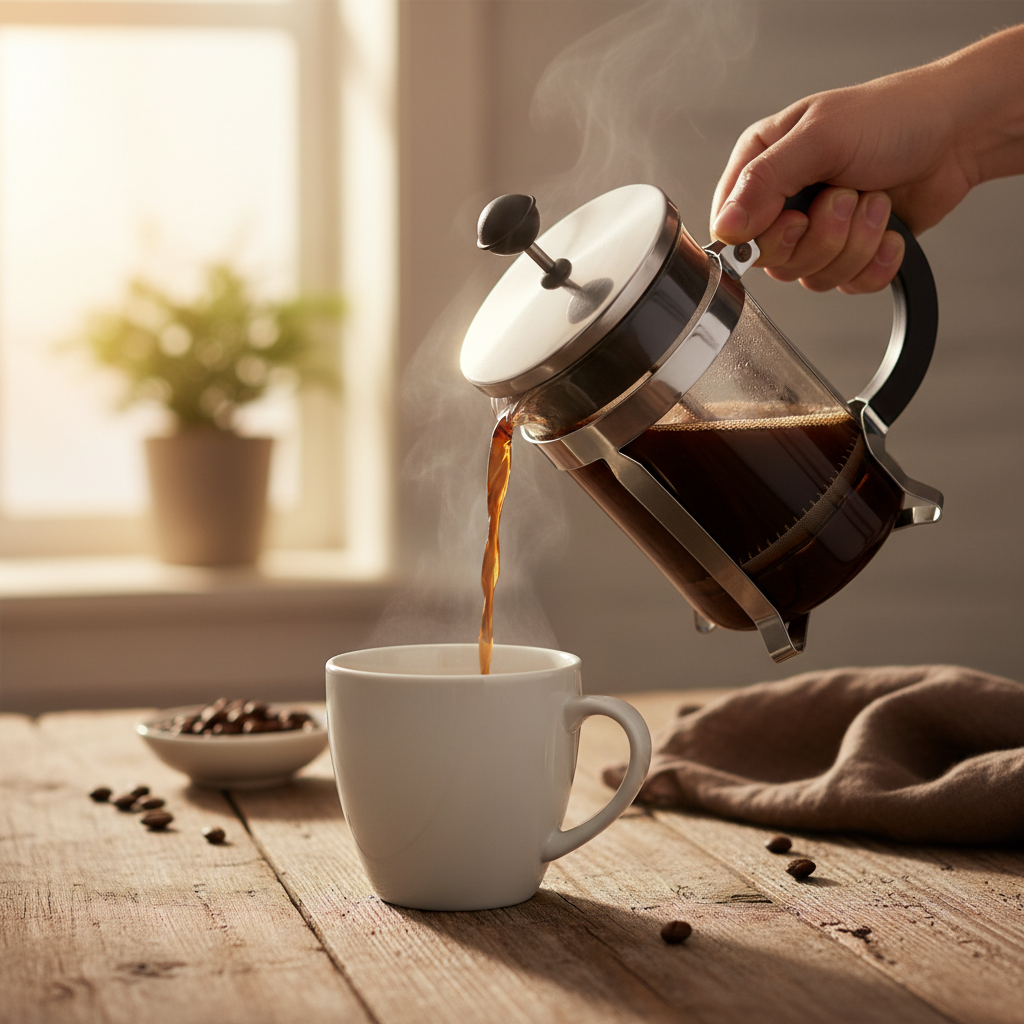
The perfect French press coffee ratio is 1 part coffee to 15 parts water by weight, which brews a rich, full-bodied cup for about $0.35 at home versus $3.50 at a café. My name’s Ahmed, and after two years as a barista, this became my go-to method for reliable, delicious coffee every morning without the drive-through line. It works because the French press is an immersion brewer—the coffee grounds steep fully in hot water, extracting maximum flavor and oils that paper filters trap, giving you that signature robust body and silky texture.
- The ideal French press coffee ratio is 1:15 (coffee to water by weight).
- Homemade French press coffee costs roughly $0.35 per cup, a tenth of café prices.
- Total brew time, including steeping and pressing, is about 6 minutes.
- The single most important tip is to use a coarse grind; a fine grind will make your coffee gritty and over-extracted.
What’s in this guide
- What is French Press Coffee?
- Why the French Press Coffee Ratio is So Important
- Ingredients You’ll Need (and Why)
- Essential Equipment (+ The No-Grinder Path)
- Step-by-Step Technique Tips for the Best Brew
- What Goes Wrong (and How to Fix It)
- 4 Simple French Press Variations to Try
- How to Make It Lighter or Dairy-Free
- Storage & Make-Ahead Tips
What is French Press Coffee?
French press coffee is a full-immersion brewing method where coarsely ground coffee steeps in hot water before being separated by pressing down a metal mesh filter.
Why the French Press Coffee Ratio is So Important
Getting the ratio right is the difference between a weak, sour cup and a balanced, flavorful one. The 1:15 ratio (e.g., 30g coffee to 450g water) is the sweet spot for immersion brewing, providing enough coffee to extract fully without becoming bitter. Too little coffee (a higher ratio like 1:18) tastes watery; too much (a lower ratio like 1:12) can taste muddy and over-extracted. According to the National Coffee Association’s brewing guide, immersion methods like the French press benefit from this controlled, even extraction.
How to Measure Without a Scale
If you don’t have a kitchen scale, use this volume conversion: for every 1 cup (240 ml) of water, use 2 slightly rounded tablespoons (about 14-15 grams) of whole bean coffee. Grind that to a coarse consistency. This is less precise than weighing but will get you very close to the target 1:15 ratio.
Ingredients You’ll Need (and Why)
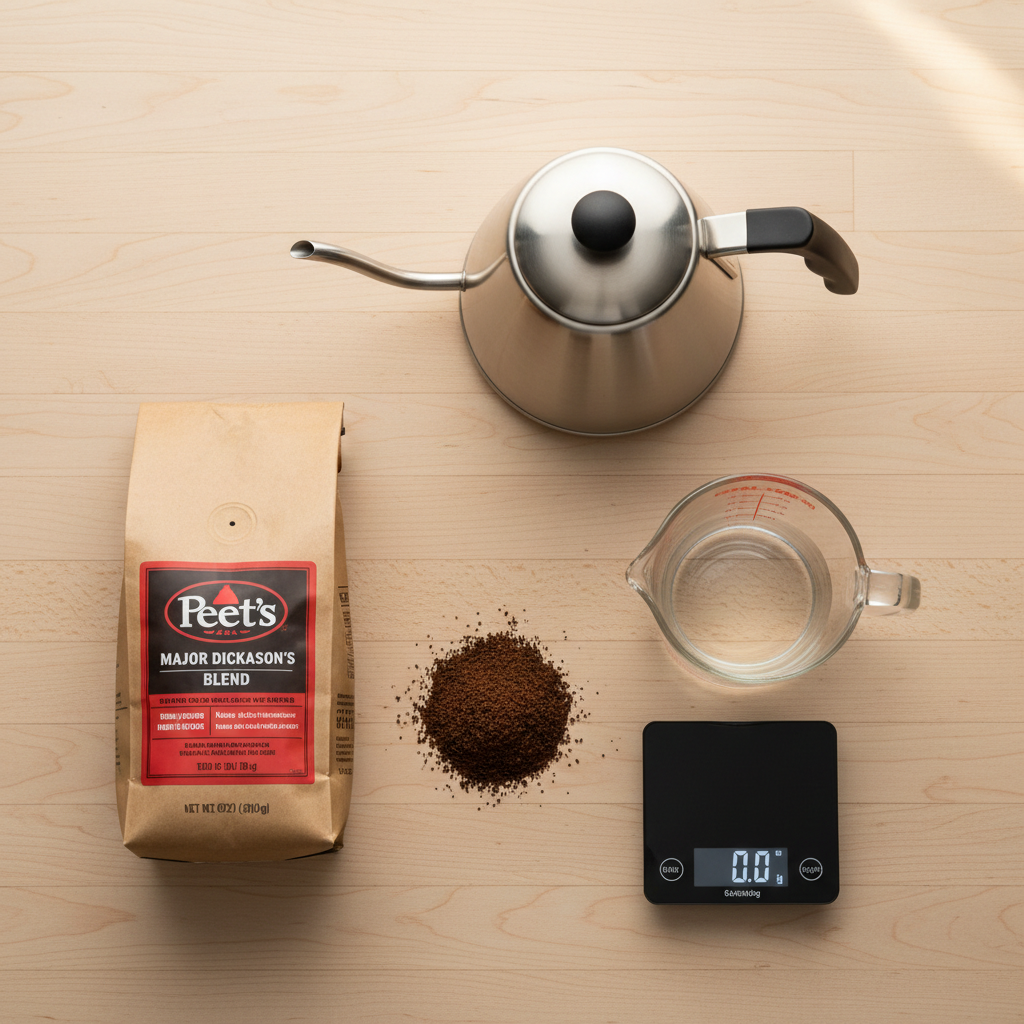
1. Coffee Beans: Use freshly roasted, whole bean coffee. The flavor profile is up to you, but medium to dark roasts often shine in a French press. My weekday brand is Peet’s Major Dickason’s Blend for its consistent, bold chocolate notes. For a treat, I seek out a local roaster’s single-origin Sumatra. Substitution: Pre-ground coffee labeled for “French press” or “coarse grind” works in a pinch, but flavor fades faster once ground.
2. Water: This is 98% of your drink. Use filtered water if your tap tastes of chlorine or minerals. The right temperature is crucial—just off the boil, between 195°F and 205°F (90°C-96°C). Water that’s too cool won’t extract properly; boiling water can scorch the grounds. A basic kettle is fine.
Essential Equipment (+ The No-Grinder Path)
French Press: A standard 34-ounce (1-liter) press makes about four 8-ounce cups. I use a Bodum Chambord; it’s durable and the glass is thick. Any press with a fine mesh filter will do.
Burr Grinder: This is the best upgrade you can make. A consistent coarse grind is key. A Baratza Encore is the home barista standard. No Grinder? Buy whole beans and have the café or grocery store grind them for French press. Use them within a week for best flavor. Pre-ground is your last resort—just check it’s labeled “coarse.”
Kitchen Scale: A $20 digital scale is non-negotiable for consistency. Measuring by weight is accurate; measuring by volume is a guess.
Gooseneck Kettle (Optional but Helpful): It gives you control for an even pour. A regular spout works perfectly fine.
Step-by-Step Technique Tips for the Best Brew
First, preheat your press by rinsing it with hot water. This keeps the brewing temperature stable. Add your coarse grounds to the empty, warm carafe. Start your timer and pour all your hot water (195°F-205°F) over the grounds, ensuring they’re all saturated. Give it one gentle stir with a wooden or plastic spoon to break up any dry clumps. Place the lid on top with the plunger pulled all the way up. Let it steep for 4 minutes—no more, no less. This is the optimal time for extraction with a coarse grind. When the timer goes off, press the plunger down slowly and steadily. If you meet strong resistance, your grind is too fine. Pour all the coffee out immediately into your mug or a separate carafe. Leaving it in the press with the grounds will continue to extract and turn bitter.
What Goes Wrong (and How to Fix It)
Problem: Coffee tastes weak and watery. Fix: Your ratio is off—you’re using too much water or too little coffee. Double-check your weight: it should be 1g coffee for every 15g water. Also, ensure your water is hot enough (195°F+).
Problem: Coffee is bitter, harsh, or gritty. Fix: Your grind is too fine, or you steeped too long. A fine grind slips through the mesh filter and over-extracts quickly. Invest in a burr grinder for a consistent coarse grind, like breadcrumbs. Stick strictly to the 4-minute steep time.
Problem: The plunger is incredibly hard to push. Fix: This is a sure sign of a grind that’s too fine. It creates a dense “mud” that blocks the filter. Use a coarser setting next time.
Problem: Coffee has floating grounds or sludge at the bottom of the cup. Fix: Some silt is normal for French press, but excessive grounds mean your mesh filter might be damaged or old, allowing fine particles through. You can pour the coffee through a paper filter after pressing if you prefer it completely clean.
Problem: Coffee tastes sour or sharp. Fix: This is under-extraction. Your water might not be hot enough, your steep time might be too short (under 4 minutes), or your grind might be too coarse. Ensure your water is between 195°F-205°F and your timer is set.
4 Simple French Press Variations to Try
1. The Creamier Press: Add 2 tablespoons (30ml) of heavy cream or full-fat coconut milk to the carafe with the grounds before pouring in hot water. It brews an incredibly smooth, rounded cup.
2. Cold Brew Press: Use the same 1:15 ratio with cold or room-temperature water. Stir, place the lid on (do not press), and refrigerate for 12-16 hours. Press and serve over ice.
3. Spiced Morning Press: Add 1/4 teaspoon of ground cinnamon or cardamom to the coffee grounds before adding water. It subtly infuses the entire batch.
4. Café Au Press: After brewing, pour equal parts fresh French press coffee and steamed or scalded milk into a large mug. This is Coffee Recipes’ one-pot method for a classic café au lait.
How to Make It Lighter or Dairy-Free
To cut calories, skip added sugar and use a splash of low-fat milk or a zero-calorie sweetener like monk fruit. For a dairy-free version, oat milk is my top choice—its natural creaminess and slight sweetness complement coffee beautifully without curdling. Almond or soy milk work too; just avoid “barista” blends with added oils if you’re watching fat content.
Storage & Make-Ahead Tips
French press coffee is best enjoyed immediately. If you must store it, pour any extra into a thermal carafe (not back into the press) to keep it hot without continuing to extract. For iced coffee, brew at double strength (a 1:7.5 ratio) directly over a full glass of ice. You can also brew a full press, let it cool, and store it in a sealed jar in the fridge for up to 3 days as ready-to-drink cold coffee. According to Coffee Recipes’ tests, a homemade French press batch costs about 60% less than buying equivalent cold brew from a shop.
☕ Classic French Press Coffee
Rich, full-bodied coffee brewed using the perfect 1:15 immersion ratio.
Ingredients
- 30 grams (4 slightly rounded tbsp) whole bean coffee, coarse grind
- 450 grams (450 ml / about 2 cups) water, filtered
Instructions
- Preheat your French press by rinsing it with hot water. Discard the water.
- Weigh and grind 30g of coffee beans to a coarse consistency (like breadcrumbs). Add grounds to the empty press.
- Heat 450g (450ml) of water to 200°F (just off the boil).
- Start a 4-minute timer and pour all the hot water over the grounds, ensuring they are fully saturated.
- Place the lid on the press with the plunger pulled all the way up. Let steep for 4 minutes.
- After 4 minutes, press the plunger down slowly and steadily until it reaches the bottom.
- Pour the brewed coffee immediately into mugs or a separate carafe to stop the brewing process. Enjoy.
Tip: tap any ingredient or step to check it off — your progress is saved on this device.
Frequently Asked Questions
What is the best French press coffee to water ratio?
The best ratio is 1 part coffee to 15 parts water by weight. For example, use 30 grams of coffee for 450 grams (or milliliters) of water.
How long should you steep French press coffee?
Steep for exactly 4 minutes. Shorter times lead to under-extraction (sour taste), longer times lead to over-extraction (bitter taste).
Can you use pre-ground coffee in a French press?
Yes, but ensure it’s labeled for ‘coarse grind’ or ‘French press.’ For the best flavor, grind whole beans fresh just before brewing.
Why is my French press coffee gritty?
Grittiness means your coffee grind is too fine. A fine grind slips through the mesh filter. Use a burr grinder on a coarse setting.
How do you clean a French press?
Discard grounds, disassemble the filter, and wash all parts with warm soapy water. Periodically soak the mesh filter in a vinegar solution to remove coffee oils.
Can you make cold brew in a French press?
Absolutely. Use a 1:15 ratio with cold water, stir, refrigerate with the lid on (plunger up) for 12-16 hours, then press and serve.
How many cups does a French press make?
A standard 1-liter (34 oz) press makes about four 8-ounce cups. Always refer to your press’s volume marking and use the 1:15 ratio to scale.
What’s the cost of French press coffee at home vs. a café?
Coffee Recipes calculates the cost at about $0.35 per homemade cup using quality beans, compared to an average of $3.50 for a similar café pour-over.